In Memoriam
Hugh Michael O’Brien IV
31 July 19693 August 2026
Requiem Mass
according to the Missale Romanum of 1962
Our Lady of the Atonement
15415 Red Robin Road
San Antonio, Texas 78255
Friday, the twentieth of November
Two thousand and twenty-six
Half past seven in the evening

Hugh Michael O’Brien IV 31 July 1969 — 3 August 2026
The Invitation
The family of Michael O’Brien warmly invite you to a Requiem Mass offered for the repose of his soul.
Michael was buried in San Diego in September. This Mass is offered for him again, among those who could not be there.
Let Us Know You’re Coming
You don’t need to reply to come. But if you think you’ll be there, it helps us to know. If enough of us are coming, the family may gather afterwards.
It takes a moment, and nothing is required of you.
The Requiem Mass
Our Lady of the Atonement
15415 Red Robin Road · San Antonio, Texas 78255
Celebrant
Rev. Fr. Armando Alejandro
Choirmaster
Jeremy Daggett
Master of Ceremonies
James Griffin
The Music
The Mass will be sung by an ensemble of ten voices, two to each part, in the setting of the Missa pro defunctis a 5 by Cristóbal de Morales (c. 1500–1553), published at Rome in 1544 while its composer sang in the chapel of the Pope.
Morales’ polyphony was sung over the Emperor’s catafalque at the exequies of Charles V in Mexico City in 1559 — an account of which survives in Francisco Cervantes de Salazar’s Túmulo imperial de la gran ciudad de México, printed there the following year.
About This Mass
The rite you assist at this evening is the Traditional Latin Requiem Mass, offered according to the Roman Missal of 1962. The Church’s word is assist, not attend. You are not here as an audience.
It takes its name from the first word of its opening chant, the Introit — Requiem, rest — and from the first thing that chant asks of God: Requiem æternam dona eis, Domine, et lux perpetua luceat eis. Eternal rest grant unto them, O Lord, and let perpetual light shine upon them. Two petitions, rest and light; and the Church returns to them all evening — at the Communion, and in the last words that will be said over him.
Rest here does not mean sleep. The word carries what St. Augustine gave it in the first paragraph of the Confessions: fecisti nos ad te, et inquietum est cor nostrum donec requiescat in te — Thou hast made us for Thyself, and our heart is restless until it rests in Thee. His verb is requiescat, the same root as Requiem. What the Church asks for Hugh Michael this evening is not repose but arrival: an end to the restlessness, in God.
A Requiem, then, is a Mass offered for one who has fallen asleep in the Lord — St. Paul’s phrase, from the very Epistle you will hear sung this evening: concerning them that are asleep, that you be not sorrowful, even as others who have no hope. It begs that God grant Hugh Michael that rest.
The Requiem is not a celebration of Hugh Michael’s life. It is something the Church believes will serve him better than praise: the offering of the Sacrifice of Calvary for the repose of his soul. Everything you will see follows from that. The vestments are black. The candles are unbleached. There is no Gloria, no Alleluia, no final blessing, and the organ is silent except to hold up the voices. The Church does not pretend that death is nothing, and she does not presume to announce where a soul has gone — for judgment belongs to God alone, and St. Paul warns us to “judge not before the time, until the Lord come,” saying that he does not even judge himself: “I judge not my own self; but he that judgeth me, is the Lord.” She mourns, and she prays, and she asks you to do the same, as the Church has done since apostolic times and as Scripture teaches: “It is a holy and wholesome thought to pray for the dead, that they may be loosed from sins.” She does it full of hope in the resurrection of Our Lord Jesus Christ.
Much of what follows is sung in Latin, and much of it is prayed silently by the priest at the altar. Do not worry about following every word. This is an explanation, meant to be read before Mass begins; the pages that follow set out the background to each part of the rite.
If you carry one line out of this church, let it be the one the priest sings in the Preface: vita mutatur, non tollitur — life is changed, not taken away.
During the Mass
The pattern is different from what you may be used to. Follow the people around you — no one is keeping score, and no one will think less of you for staying seated.
From the Sanctus until the Pater Noster the priest prays the Canon almost inaudibly. That stretch of quiet is not a pause. It is the most solemn part of the Mass, and the best moment you will have this evening to pray for Hugh Michael in your own words.
Communion is received kneeling at the altar rail and on the tongue. It is for Catholics who are prepared to receive it. Everyone else — and you are genuinely welcome here — is asked simply to remain in the pew and pray. Coming forward with arms crossed for a blessing is not the custom in this rite, so please don’t feel you are expected to.
Many of the women present will wear a veil. It is a custom, not a requirement, and its absence will not be noticed.
Please, none during the Mass.
The Order of the Mass
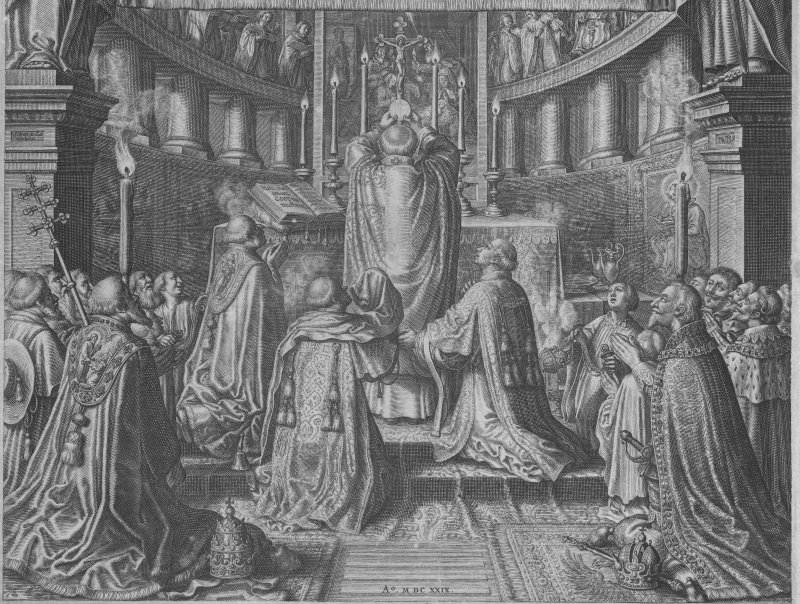
This section describes, in sequence, the prayers of the Mass. Where a name is underlined, you can tap it to hear the chant.
Reception of the Body
Prayed at the door of the church as the priest receives the body, with the antiphon Si iniquitates observaveris: If Thou, O Lord, wilt mark iniquities. Out of the depths I have cried to Thee, O Lord. The Church does not open in consolation. She begins at the bottom, begging the Lord for forgiveness on behalf of the faithful departed. Then turns to acknowledge the Lord’s mercy: with Thee there is merciful forgiveness. The psalm’s penitential use is early Christian. It’s one of the seven Penitential Psalms, used in the East and the West, by the early Christians. It’s also one of the fifteen Gradual Psalms sung by Jewish pilgrims going up to Jerusalem, so it was already ancient when the Church received it.
Sung during the procession. The antiphon is Exsultabunt Domino ossa humiliata: the bones that have been humbled shall rejoice. One of the seven Penitential Psalms, prayed as such by Christians in the East and the West from the early centuries, and David’s own repentance after Nathan came to him. Of the psalm’s twenty-one verses, the Church chose the tenth — the only one that mentions bones — and sings it over a body being carried to burial. The humbling is death; the rejoicing is the resurrection of the body. So the procession is penitence in the psalm and hope in the antiphon, at the same moment.
The priest meets the coffin at the door of the church as the Subvenite is chanted, calling on the whole company of heaven to come out to meet him and carry him home: Come to his aid, saints of God; hasten to meet him, angels of the Lord. A pall is laid over the coffin, and he is carried in and set down before the sanctuary, his feet toward the altar.
Mass of the Catechumens
The Introit, from the Latin introitus, a going-in, is the chant sung as the priest approaches the altar. At a Requiem its first words are Requiem æternam dona eis, Domine — eternal rest grant unto them, O Lord — which is how this Mass got its name. The Gloria Patri, sung at every other Mass of the year, is omitted.
While the choir sings, the priest and servers stop at the foot of the altar and pray there in a low voice. At a Requiem this opening is much shortened: Psalm 42, Judica me, is omitted, as it is throughout Passiontide, because it opens in gladness. What remains is the confession. The priest says the Confiteor, and the servers say it after him, each striking his breast at mea culpa — through my fault. It is said before anything at all is asked for the dead: the men in the sanctuary ask pardon for themselves first, and only then go up to the altar to plead for Hugh Michael.
Kyrie eleison, Greek for “Lord, have mercy,” is the oldest prayer in the Mass and the only Greek that survives in a rite otherwise entirely Latin. Christians were singing it by the fourth century, and at Rome by the fifth. Nine times it is asked — three to the Father, three to the Son, three to the Spirit.
The Collect, pronounced col-lect, takes its name from what it does — the priest collects the silent prayers of everyone present into one. Listen for the invitation to pray, then a moment of silence in which to offer your own intention, then the single prayer spoken for all. It is here that Hugh Michael is first named at the altar, in Latin, as he was named at his baptism.
St. Paul writes to a congregation frightened about their dead, and tells them not to grieve as men without hope.
Sung from the step of the altar — gradus, a step. The plea for rest again, with a line of quiet confidence: the just man is held in everlasting remembrance.
Where the Alleluia would normally be sung, the Requiem sings a Tract instead: Absolve, Domine — “Absolve, O Lord.” The Church will not sing Alleluia over a coffin. Sung in the Roman Mass for the Dead for close to a thousand years, it is a plea for forgiveness: “Absolve, O Lord, the souls of all the faithful departed from every bond of sin.”
Dies iræ, dies illa — day of wrath, that day. Nineteen rhyming stanzas on the Last Judgment, written in the thirteenth century and commonly attributed to the Franciscan Thomas of Celano, who knew St. Francis. It is the longest chant of the morning. Listen for the turn: halfway through it stops describing the judgment and begins to plead, and it ends almost in a whisper — Pie Jesu Domine, dona eis requiem. Merciful Lord Jesus, grant them rest.
Martha tells Christ He has come too late. He answers: I am the resurrection and the life. The Gospel is not carried with candles, as it would be on a Sunday; the servers take their places beside the book with empty hands, and there is no incense. Even the ceremonies are in mourning.
Mass of the Faithful
A prayer that St. Michael bring the soul into holy light — the same promise once made to Abraham. While it is sung the priest offers the bread and the chalice in a series of quiet prayers, washes his hands at the Lavabo, and turns once to ask that his sacrifice and yours be acceptable to God. Incense returns here for the first time this evening, and the drop of water mixed into the wine goes in unblessed — at every other Mass it would be blessed first.
The heart of the rite: in Christ, life is changed, not taken away — vita mutatur, non tollitur.
Holy, holy, holy. The song of the angels, joined by everyone in the building. Kneel at its end.
Prayed silently, in a voice the congregation is not meant to hear. This is what makes the Mass a Mass. Over the bread and the wine the priest speaks the words of Christ, and what lies on the altar is no longer bread and wine: the whole substance is changed, the appearances alone remaining, and Jesus Christ is present — Body, Blood, Soul and Divinity, the whole Christ, truly, really and substantially. The Council of Trent gave the change its name: transubstantiation. He genuflects, raises the Host, and then the chalice, for you to adore. Later in the same prayer he pauses, and names Hugh Michael before God — not in passing, and not at the edge of the morning, but here, with Christ present upon the altar. This is the Church’s love for him: she waits until she holds her Lord in her hands, and then she asks.
The Our Father, sung by the priest alone. Forgive us our trespasses — asked here for someone who can no longer ask it himself.
Listen for the change. At every other Mass the response is have mercy on us. Here it is grant them rest — and the third time, rest everlasting.
May everlasting light shine upon him, with Thy saints forever. Sung while the faithful receive.
In place of Ite, missa est. The dismissal is not “go” but “may they rest in peace.” There is no final blessing.
Hugh Michael O’Brien IV
Hugh Michael O’Brien IV — “Mike” — 57, of San Diego, California, passed away on 3 August 2026 at UC San Diego Jacobs Medical Center, surrounded by his family, after a three-and-a-half-year fight with stage 4 pancreatic cancer.
He was born on 31 July 1969 in Subic Bay, Philippines, to Hugh Michael O’Brien III and Julie Apelo O’Brien. After graduating from George Dewey High School he attended San Diego State University, where he received a Bachelor of Science in Computer Science. He spent thirty years as a software engineer, most of them with defense contractors, including more than twenty years at L3Harris.
He met Maribelle in college in 1989. They married in 1993 and received the sacrament of holy matrimony in the Catholic Church in 1998. They built their family and their home in San Diego and worshipped at St. Anne Catholic Church, where Mike loved the Traditional Latin Mass.
He was a devoted husband, father, and brother. He loved figuring out how things worked and making them better, and he loved the outdoors, camping, and the open road. A man of deep faith, he met his illness with grace, humor, and courage.
Survived By
('Their children', 'Mikey (Ashley), Marisa (Noah), and Maria')
('His mother', 'Julie Apelo O’Brien')
('His siblings', 'Tara, Tim, Sammi Jo, and Kimberly')
In His Own Words
Regarding prayer, I believe it’s the reason I am still here. Prayers really do make a difference. One of the reasons I share my cancer fight is because it’s an opportunity to have more people praying for me. I’ll definitely be praying for you. Love you, Mike.
I love you too, Tim. I forgot about the arguments long ago.
Prayer for the Departed
Psalm 129 · De Profundis
traditionally prayed for the souls of the faithful departed
De profundis clamavi ad te, Domine: Domine, exaudi vocem meam.
Out of the depths I have cried to Thee, O Lord: Lord, hear my voice.
Fiant aures tuæ intendentes in vocem deprecationis meæ.
Let Thine ears be attentive to the voice of my supplication.
Si iniquitates observaveris, Domine: Domine, quis sustinebit?
If Thou, O Lord, wilt mark iniquities: Lord, who shall endure it?
Quia apud te propitiatio est: et propter legem tuam sustinui te, Domine.
For with Thee there is merciful forgiveness: and by reason of Thy law I have waited for Thee.
Sustinuit anima mea in verbo ejus: speravit anima mea in Domino.
My soul hath relied on His word: my soul hath hoped in the Lord.
A custodia matutina usque ad noctem: speret Israel in Domino.
From the morning watch even until night, let Israel hope in the Lord.
Quia apud Dominum misericordia: et copiosa apud eum redemptio.
Because with the Lord there is mercy: and with Him plentiful redemption.
Et ipse redimet Israel ex omnibus iniquitatibus ejus.
And He shall redeem Israel from all his iniquities.